A woman spent six months asking her neighbor to stop using her driveway as a personal parking spot. But after the neighbor caused her to miss an important appointment, she came up with a plan that left the woman trapped behind 30 cars one morning.
For six months, my neighbor Linda treated my driveway like it belonged to her.
It started innocently.
“Just ten minutes,” she’d say, leaving her SUV there while visiting someone across the street.
Then ten minutes became two hours.
Soon, she’d park there overnight.
I asked politely.
Then firmly.
I even put up a “PRIVATE DRIVEWAY” sign.
Linda laughed.
“You barely use it anyway.”
She was right about one thing.
Since my husband, Robert, died two years earlier, I only had one car.
But that didn’t make my property hers.
Before Robert died, our driveway was rarely empty.
He loved classic cars. Not in the casual, “That’s a nice Mustang” sort of way. He could hear an engine from half a block away and tell you what was wrong with it.
For more than 20 years, he belonged to a local classic-car club.
Our house became one of their favorite gathering places.
Every September, Robert and I hosted breakfast in the backyard. Cars would line the driveway and the private gravel lane behind our house.
Robert would be outside before sunrise, directing everyone like an airport employee.
“Move that Chevy another foot!”
“Robert, nobody can hear you over the engines!” I’d yell.
“That’s why I’m yelling!”
After he died, I stopped hosting.
I stopped attending club events as well.
Seeing all those cars without Robert among them hurt more than I expected.
So the driveway became quiet.
Linda apparently saw that emptiness as an invitation.
The first time she parked there, I didn’t care.
The fifth time, I did.
“Linda, could you please use your own driveway?”
“I’m only going across the street.”
“That’s fine, but this is still my driveway.”
She moved.
The next week, she did it again.
Eventually, I stopped asking nicely.
One afternoon, I found her SUV there while carrying groceries home.
I walked next door.
“Linda, we’ve talked about this.”
She sighed.
“I’ll move it later.”
“I need you to move it now.”
“Why?”
“Because it’s my driveway.”
“Carol, you have one car and enough space for six.”
“That’s not the point.”
“You barely use it anyway.”
There was that sentence.
Again.
As though ownership expired when something wasn’t being used enough for Linda’s liking.
I put up the sign the next day.
She parked directly beneath it that weekend.
I should have done something then.
Instead, I kept trying to avoid a neighborhood war.
Then came the doctor’s appointment.
It was at 7:30 a.m. on a Thursday.
I’d waited almost two months for it.
I showered, got dressed, grabbed my bag, and walked outside at 6:50 a.m.
Linda’s SUV was blocking me.
I stared at it.
Then I marched next door.
I knocked.
Nothing.
I rang the bell.
Nothing.
I called her.
Straight to voicemail.
I knocked again.
“Linda!”
No answer.
For fifteen minutes, I stood there.
At 7:10 a.m., I called the doctor’s office and explained.
They told me if I arrived more than 15 minutes late, they couldn’t guarantee I’d be seen.
I tried Linda again.
Nothing.
I missed the appointment.
The earliest they could reschedule me was three weeks later.
That afternoon, I saw Linda walking toward her SUV.
I went outside.
“I’ve been trying to reach you.”
“Oh.”
“You blocked my car this morning.”
“Sorry. I was sleeping.”
“I missed a doctor’s appointment.”
She looked mildly annoyed, as if I’d just informed her that her dog had barked.
“Couldn’t someone have driven you?”
“That isn’t the point.”
“I said I’m sorry.”
Then she smiled.
Not apologetically.
Dismissively.
Like the entire conversation was silly.
“You should’ve told me you needed the driveway this morning.”
I stared at her.
“I have to tell you when I need my own driveway?”
She shrugged.
“You barely use it anyway.”
That smile gave me an idea.
Not immediately.
But by that evening, I knew exactly what I was going to do.
I went inside and opened a drawer I hadn’t touched in months.
Robert’s car-club directory was still there.
I found the number for George, the club president.
He answered on the fourth ring.
“Carol?”
“Hi, George.”
“Well, this is a surprise.”
“I have a strange question.”
“Those are usually the best kind.”
I looked out the window at my empty driveway.
“Is the offer to host everyone again still open?”
There was a pause.
Then, he asked, “Are you serious?”
“I think so.”
“You tell me when.”
“Monday.”
Another pause.
“Monday morning?”
“Seven.”
George laughed.
“Robert would’ve liked whatever you’re planning.”
“You don’t even know what I’m planning.”
“I knew your husband for 27 years. I’m willing to take the gamble.”
I explained that I wanted breakfast in the backyard.
Nothing fancy.
Coffee, pastries, eggs, whatever people wanted to bring.
Then I added, “And George?”
“Yeah?”
“Bring everybody.”
He did.
The following Monday, Linda parked in my driveway at 6:45 a.m.
I watched from my kitchen window.
I couldn’t believe my luck.
She pulled in, got out, and walked back toward her house.
Apparently, her own driveway was going to be used by a landscaping crew that morning.
She didn’t knock.
Didn’t ask.
Didn’t even look at my sign.
At 7:00 a.m., the first car arrived.
A red 1967 Mustang.
George waved through the windshield.
I directed him behind Linda.
Then another car came.
And another.
A Corvette.
A Camaro.
Two old pickup trucks.
A beautiful blue Cadillac that Robert would’ve spent twenty minutes inspecting.
Some people brought their everyday cars because their classics weren’t running.
I didn’t care.
By 7:30 a.m., there were 18 vehicles.
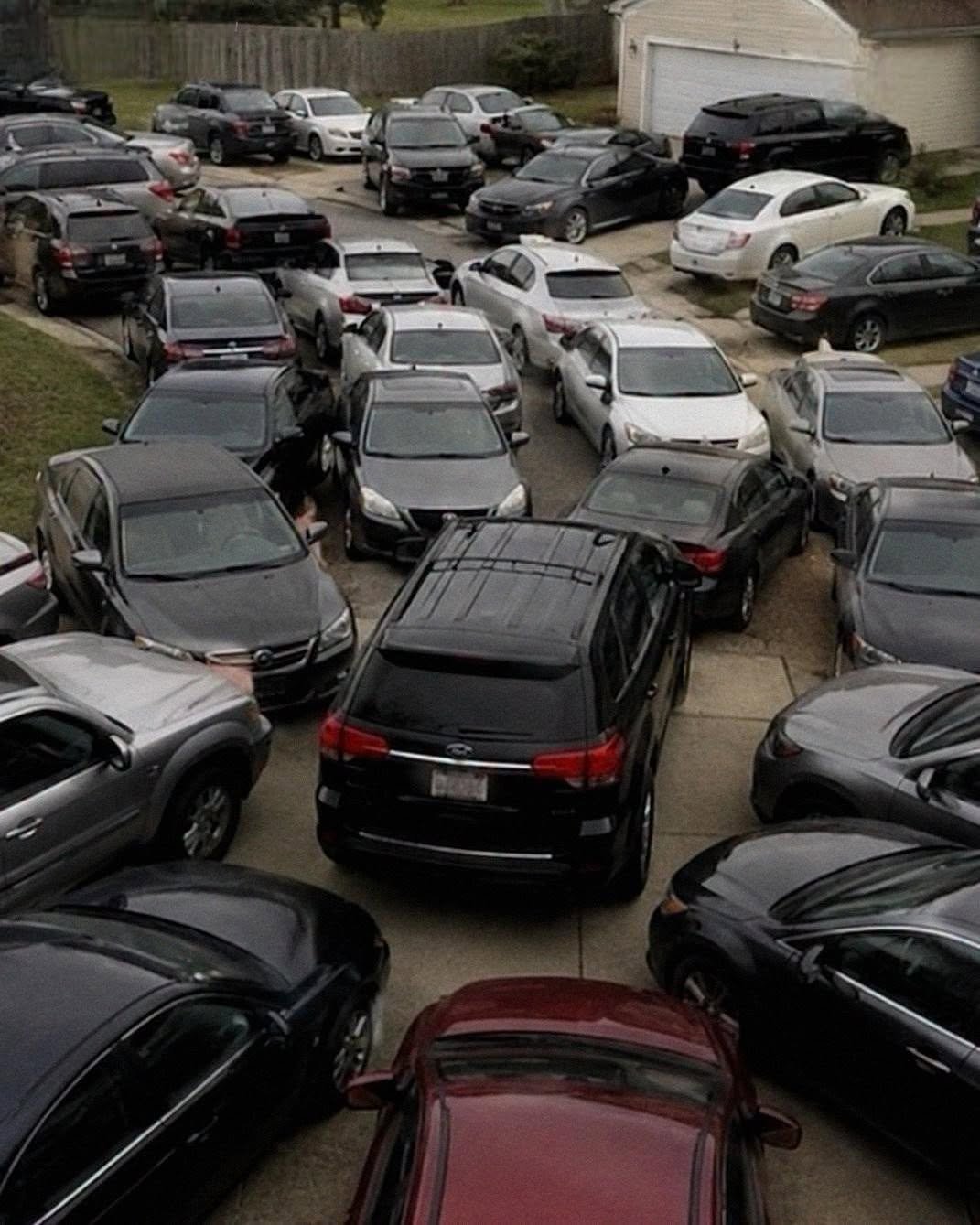
By 8:00 a.m., 30 cars were lined up behind Linda’s SUV.
Some were in my driveway.
Others filled the private gravel lane behind my house.
Everyone got out carrying something.
Coffee, folding chairs, breakfast casseroles, boxes of donuts.
One man carried enough bacon to feed a small army.
Nobody was leaving.
Instead, they were all walking toward my backyard.
I was pouring coffee when I heard Linda.
“What the hell is this?!”
I stepped onto my porch with my mug.
She was standing beside her SUV in a robe and slippers.
“Morning.”
“Move these cars!”
“I can’t.”
“What do you mean, you can’t?”
“People are eating.”
“I have work!”
I took a sip of coffee.
“You barely use your car anyway.”
Her face turned red.
“Are you serious?”
“Very.”
“You did this on purpose!”
“I invited some friends for breakfast.”
“Thirty friends?”
“Robert was popular.”
She stared past me.
Every driver had gotten out.
Nobody was leaving.
Linda pointed at her SUV.
“I’m blocked in!”
“Yes.”
“You need to tell them to move.”
“Eventually.”
“Eventually? I have to leave now!”
“That’s unfortunate.”
“Carol!”
I shouldn’t have enjoyed it.
I did.
Then Linda looked toward the last car pulling into the gravel lane.
An elderly man climbed out.
He was tall, thin, and moved carefully with a wooden cane.
The moment Linda saw him, she froze.
Her coffee mug slipped from her hand.
It hit the grass.
“No…”
I recognized him immediately.
“Arthur!”
He raised a hand.
“Morning, Carol.”
Arthur was 82.
He’d lived in the neighborhood long before Robert and I arrived.
In fact, decades earlier, his family had owned much of the land along our side of the street.
Arthur eventually divided part of it into separate lots.
Years later, he sold the house next door to Linda.
He was also one of the oldest members of Robert’s car club.
Arthur reached the driveway and stopped.
He looked at Linda.
Then at her SUV.
Then at the line of cars behind it.
“Linda?”
She said nothing.
Arthur pointed with his cane.
“Don’t tell me that’s your vehicle.”
“It’s complicated.”
He looked around.
“Not really.”
Linda crossed her arms.
“I parked here for a little while.”
Arthur frowned.
“Why?”
“My driveway is being used this morning.”
“So?”
Linda glanced at me.
“It’s not like Carol needs all this space.”
Arthur’s expression changed.
“I showed you the property line myself.”
Silence.
I looked at Linda.
“You knew?”
She avoided my eyes.
Arthur continued.
“When you bought the house, you asked me specifically about overflow parking. I told you this driveway and the gravel lane belonged to the property next door.”
Linda looked furious.
“I know whose driveway it is.”
There it was.
For six months, part of me had wondered whether she genuinely believed the gravel lane was shared.
She didn’t.
She had always known.
She just didn’t care.
Arthur shook his head.
“Then why are we having this conversation?”
“Because she blocked me in!”
Arthur looked at her SUV again.
“Seems to me you blocked yourself in.”
I had to hide my smile behind my coffee.
Linda didn’t appreciate that.
“I’m calling the police.”
“Okay,” I said.
That surprised her.
“What?”
“Call them.”
So she did.
Then she went inside to change.
Meanwhile, breakfast continued.
I walked into the backyard.
For the first time in two years, it sounded like one of Robert’s mornings again.
People laughing.
Car doors closing.
Someone arguing about engines.
George was attempting to cook eggs on a portable griddle while three different men told him he was doing it wrong.
I laughed.
Really laughed.
And it caught me by surprise.
George looked over.
“There she is.”
“What?”
“We’ve missed that.”
I knew exactly what he meant.
One of the club members, Diane, handed me a cup.
“Robert’s coffee.”
I looked inside.
Black.
One sugar.
“He would’ve complained that you put the sugar in before giving it to him.”
“I know.”
My throat tightened.
Diane reached into her bag.
“I brought something.”
She handed me a photograph.
It had been taken in our driveway about eight years earlier.
Robert stood beside his old Pontiac with both hands raised because apparently somebody had caught him in the middle of giving instructions.
There were cars everywhere.
I touched the edge of the photograph.
“I’d forgotten this.”
“We haven’t.”
Arthur appeared beside me.
He looked around the yard.
“Robert would be happy to see this driveway full again.”
I swallowed.
“Yeah.”
For six months, Linda had kept telling me I barely used the driveway.
She wasn’t entirely wrong.
What she didn’t understand was why.
The driveway hadn’t become empty because it stopped mattering.
It became empty because Robert did.
Or at least, that was how I’d felt.
Around nine, a police car pulled up.
Linda came outside immediately.
The officer spoke to her first.
Then he came over to me.
“Are you the property owner?”
“Yes.”
“And these people are your guests?”
“Yes.”
“Do you know the owner of that SUV?”
“My neighbor.”
“Did you give her permission to park here?”
“No.”
He glanced toward the PRIVATE DRIVEWAY sign.
“Have you asked her not to?”
“Repeatedly.”
Linda interrupted.
“That’s not the issue. She’s deliberately blocking my vehicle.”
The officer looked at her.
“Ma’am, is your vehicle parked on your property?”
Linda hesitated.
“No, but—”
“Did she give you permission to park here today?”
“No.”
He looked at me.
“Can these vehicles be moved enough to let her retrieve the SUV?”
“After breakfast, absolutely.”
Linda exploded.
“After breakfast? I have work!”
The officer held up a hand.
“I’m trying to resolve this without making it more complicated.”
I wasn’t interested in turning the situation into a legal battle either.
I’d made my point.
I asked George and two others to move their cars.
Within ten minutes, there was enough space for Linda to back out.
Before she left, the officer spoke to her privately.
I didn’t hear everything.
But I heard enough.
“…explicitly told not to park…”
“…private property…”
“…future arrangements…”
Linda drove away without looking at me.
Breakfast lasted until almost noon.
When the last car left, I stood in the driveway alone.
For the first time, it didn’t look empty.
It just looked like a driveway.
That felt like progress.
Three days later, Linda knocked.
I opened the door.
She didn’t say hello.
“You made me look like an idiot.”
“I didn’t park your car in my driveway.”
“You invited 30 people knowing I was parked there.”
“Yes.”
“That’s unbelievably childish.”
“Possibly.”
“You could’ve just asked me to move.”
I stared at her.
“I did.”
She opened her mouth.
“For six months, Linda.”
She closed it.
“I asked politely. Then I asked firmly. I put up a sign. You ignored all of it.”
“I never thought it was that serious.”
“I missed a doctor’s appointment because of you.”
“I apologized.”
“You told me I should’ve warned you that I needed my own driveway.”
Her face tightened.
“You didn’t need 30 cars to make your point.”
“Apparently, one sign, six months of asking, and a missed doctor’s appointment weren’t enough.”
That finally silenced her.
Then I asked the question I’d been thinking about since Arthur arrived.
“You knew this was private property when you bought your house, didn’t you?”
Linda looked away.
“Yes.”
“Then why?”
“Because you weren’t using it.”
I shook my head.
“You don’t get to decide that something belongs to you because someone else isn’t using it enough.”
“I know.”
“No, I don’t think you did.”
She looked toward the driveway.
“Fine. I do now.”
It wasn’t an apology.
But it was probably the closest I was going to get.
Linda never parked there again.
Not once.
A few months later, I hosted another car-club breakfast.
Only 14 cars came that time.
As the first few arrived, I saw Linda come outside.
I braced myself.
She looked at the cars.
Then at me.
Without saying anything, she got into her SUV and moved it farther up her own driveway so Arthur would have more room to turn his Cadillac around near the street.
He noticed too.
When Arthur got out, he looked at Linda’s SUV.
Then at me.
“Progress?”
“Don’t jinx it.”
He laughed.
A few minutes later, he looked toward my driveway.
“Looks like you’re using it.”
I smiled.
“Turns out I am.”
But that wasn’t entirely true.
I had always been using it.
Sometimes an empty space still belongs to someone. Sometimes it carries memories nobody else can see.
And sometimes you don’t realize how much of your life you’ve stopped using until someone else’s disrespect pushes you into reclaiming it.
I thought those 30 cars were going to teach Linda a lesson.
Maybe they did.
But they taught me something too.
I’d spent two years keeping part of my life empty because Robert wasn’t here to fill it anymore.
That Monday morning, 30 cars pulled into my driveway.
And for the first time since he died, I didn’t look at all that noise and think about what I’d lost.
I thought about everyone who was still willing to show up.